
You might think that if you file a Civil Lawsuit, all claims that are filed get decided by a Jury, but you would be wrong. Instead, as the Judge has demonstrated in the celebrity litigation between Blake Lively and Justin Baldoni arising out of the filming of the movie This Ends With Us, lawsuit claims often get dismissed before the Jury decides the case at Trial.
How and Why Did the Judge Dismiss Claims in the Blake Lively v. Justin Baldoni Litigation?
Litigation erupted after the filming of the movie This Ends With Us with the lead actress, Blake Lively, suing fellow actor and director of the movie, Justin Baldoni, along with his production company and others.
Lively claimed multiple Civil Violations including Sexual Harassment, Retaliation, Breach of Contract, Civil Conspiracy and others. Lively alleged that Baldoni sexually harassed her on the movie set and then retaliated when she complained about it, and then devised a social media and publicity campaign to smear her and try to ruin her movie career.
Baldoni has aggressively defended the claims, alleging that Lively made baseless harassment claims with the purpose of taking over creative control of the film, and when it appeared she would be exposed, she filed a meritless lawsuit to try to control the narrative. Baldoni alleged he was defamed and that his career and reputation were harmed, so he filed a multi-million dollar Counterclaim against Lively.
The Judge in Federal District Court has invoked his power to strike many of the claims which will prohibit the Jury from considering that evidence or deciding those claims at Trial.
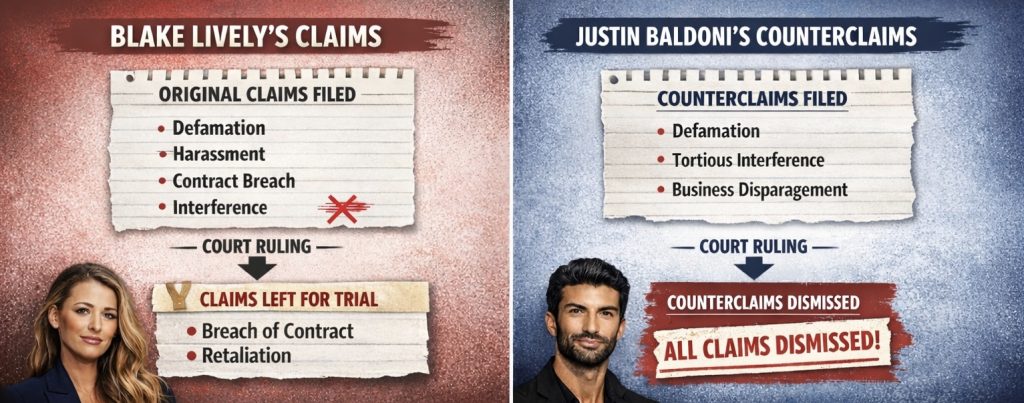
First, early on, the Judge granted Lively’s Motion to Dismiss Baldoni’s Counterclaim, finding that his claims did not justify legal compensation.
Then, just last week, in a 152 page Opinion, the Judge granted in part Baldoni’s Motion to Dismiss and Motion for Summary Judgment regarding many of Lively’s claims. Again, the Judge found that several claims were not valid and should not be decided by a Jury, including her centerpiece claim of sexual harassment.
However, a few of Lively’s claims remain including a Retaliation claim that asserts that she was mistreated after making lawful complaints of harassment and claims that Baldoni’s production company breached its contract with Lively.
Lively’s claims have been greatly reduced and so has her opportunity to air much of her “evidence” and claim certain compensation in the trial which is scheduled to start in May.
Why Should the Judge be Allowed to Dismiss Claims at Various Stages?
The law of Federal and State Courts generally allows a Judge to narrow the issues by dismissing cases at various stages in the litigation. The Judge is charged with acting as a “gatekeeper” to prevent legally insufficient claims from proceeding.
The first stage at which a claim can be dismissed is early on in the Pleadings stage after the Plaintiff has filed its Complaint. If the Judge finds that the facts in the Complaint, even if assumed to be true, do not make a valid legal claim, then the Judge will dismiss the Complaint rather than permit the Plaintiff to engage in Discovery which involves document production, depositions, subpoenas and other tools.
The Judge can also dismiss a claim after Discovery but before trial if the defendant can show that even if all the facts obtained in Discovery are true, the Plaintiff still cannot prove a viable case. If the Judge believes that is true, then there is nothing for the Jury to decide and the case should be dismissed. If, however, there are disputed facts and the Jury could find that the Defendant committed a wrongful act that justifies compensation under the law, then the case should be tried to the Jury.
How Does this Gatekeeping Role of the Judge Work in Pennsylvania State Court?
The Lively v. Baldoni case is venued in Federal Court in New York, but under the Pennsylvania State Court Rules, Judges have nearly identical obligations to dismiss certain claims rather than send them to Trial with a Jury.
First, after the Complaint is filed, the Defendant can file Preliminary Objections in the form of a Demurrer which asserts that even if everything the Plaintiff says is true, it has no viable case.
Similarly, after Discovery, a Defendant can file a Motion for Summary Judgment alleging that even if the facts uncovered in Discovery are viewed in the light most favorable to the Plaintiff, it still has no viable case.
So, like the Judge did in the Lively v. Baldoni case, Pennsylvania State Court Judges have similar obligations to act as a gatekeeper and limit the claims that get tried to a Jury.

Tim Rayne is a Pennsylvania Personal Injury lawyer who helps accident victims understand their Legal Rights and receive Fair Treatment from Insurance Companies. Contact Tim at 610-840-0124 or trayne@macelree.com or check out his website at www.TimRayneLaw.com.

Leave a Reply